

Instagram Isn't Bringing You Clients Anymore. Here's What Is.

Landen Fuller
Photographer · Louisville, KY
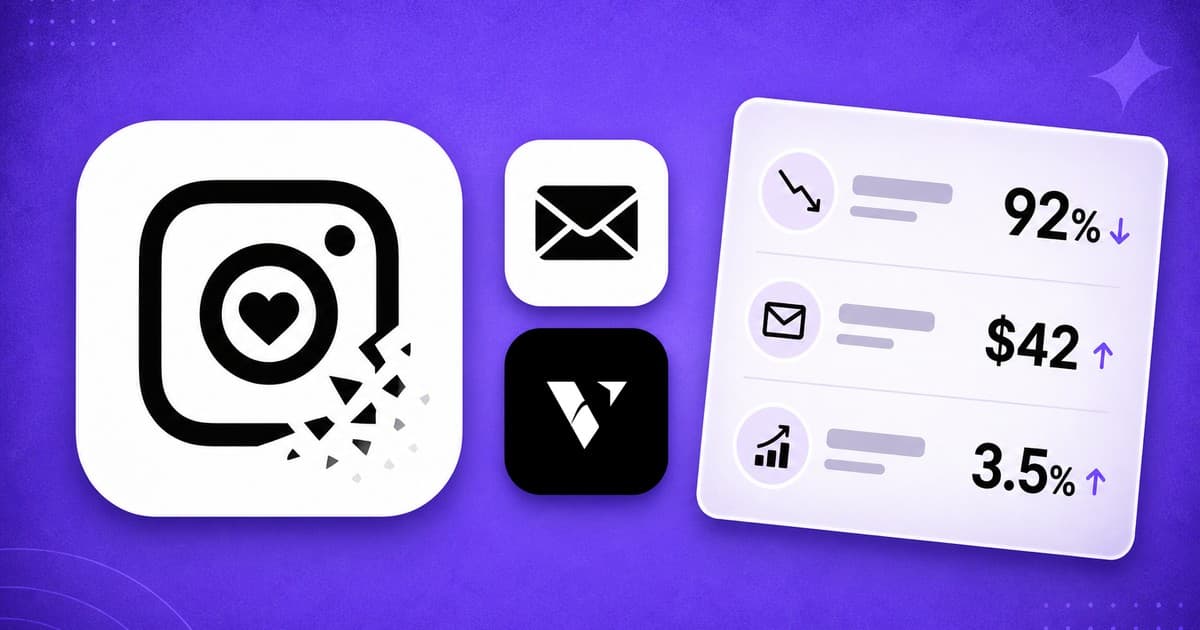
You didn't get worse at photography. Your engagement dropped anyway. If you've felt like you're shouting into a room that used to echo back and now just absorbs the sound, you're not imagining it and you're not doing anything wrong.
Here's the actual number. In 2020, a typical Instagram post reached somewhere between 10 and 15 percent of your followers. In 2026, that's down to roughly 3.5 to 7.6 percent, depending on whose data you look at, and it's still falling year over year. Business accounts got hit even harder than personal ones. One analysis tracking accounts through a recent algorithm shift found business account reach dropped 47 percent, more than double the 21 percent drop creator accounts saw in the same window. For accounts under 10,000 followers, average engagement fell from 4.7 percent down to 1.8 percent.
Read that again. Under two out of every hundred people who follow you are engaging with what you post. That's not a content problem. That's a platform doing exactly what it was built to do.
Why this happened, and why it's not you
Instagram makes its money from ads. Every dollar a business doesn't spend on promotion is a dollar Instagram isn't making. So the algorithm was tuned, deliberately, to make organic posting less reliable over time, which pushes businesses toward paying to reach the same people who already chose to follow them. That's not a conspiracy theory, it's just the business model, and it's the same story on Facebook and LinkedIn.
You can fight this. Post more Reels, chase the algorithm, study the trends, do everything right. And you might claw back some reach. But you're optimizing a channel that's structurally built to cost you more every year for the same result. At some point that's not a strategy, it's a treadmill.
What's actually working instead
Referrals. This one's been true forever and it's still true now, more than most people give it credit for. Depending on the source, somewhere between 65 and 82 percent of new business for small service businesses comes from referrals and word of mouth, and 92 percent of people say they trust a recommendation from someone they know over any ad they've seen. Referred clients convert faster, stick around longer, and don't need convincing on price the way a cold lead does.
The problem isn't that referrals don't work. It's that almost no photographer actually asks for them on purpose. They wait for referrals to happen instead of building a moment into their workflow where they're supposed to happen. The single highest-leverage move here is asking at delivery, right when the client just opened their gallery and is feeling the thing you gave them. That's the peak of the relationship. Most photographers let that moment pass silently and then wonder why referrals feel random.
Email. Boring, unglamorous, and by a wide margin the best return of any marketing channel available to you. Industry benchmarks consistently put email marketing ROI somewhere between $36 and $42 back for every dollar spent, which is not close to what social media or paid ads return. Over 80 percent of small businesses that use email say it's their primary channel for getting new customers, not just their primary channel for reminding old ones you exist.
The reason it outperforms Instagram isn't magic. It's ownership. Your list doesn't answer to an algorithm. Nobody decides that only 2 percent of the people who asked to hear from you actually get to. Every single person on your list sees what you send, or at least has the chance to, which alone puts email ahead of Instagram before you've written a word.
Search. People looking for a photographer are typing something into Google before they ever open Instagram. "Wedding photographer near me." "Family photographer that does outdoor sessions." That's a person actively looking to spend money, not someone passively scrolling. Local search returns roughly $13 for every dollar invested according to recent industry research, and yet the same research found that 61 percent of small businesses haven't put any real effort into it. That's an open lane, mostly because ranking takes months instead of hours, and most people quit before it pays off.
What building this actually looks like
None of this is a vague "diversify your marketing" platitude. Here's the concrete version.
Turn on the referral moment you already have. The second a client sees their gallery for the first time is the best five minutes you get with them all year. Put the ask right there, in the delivery email, not two weeks later in a generic newsletter. A small discount or credit on their next session for a referral that books works better than asking for the favor with nothing attached.
Start collecting email addresses everywhere, not just at booking. Every inquiry, every blog visit, every "can you send me your price list" DM should end with an email address in your list, whether that person books or not. Most of them won't book this year. Some of them will book next year, and only if you're still in their inbox when they're ready.
Write down the answers you give clients over and over, and put them on your website. What to wear. What a session actually costs. How long editing takes. Every one of those is a page that can rank on Google and pull in someone who was never going to find you on Instagram in the first place, because they weren't looking there.
What Instagram is actually still good for
Not client acquisition. Stop expecting it to do that job, it mostly can't anymore, and resenting a tool for not doing a job it's structurally not built for isn't a strategy.
It's still genuinely good at two things. Proof, for the client who already found you through a referral or a Google search and wants to see real work before they book. And relationship, for past clients who like watching your life and will think of you again when a friend gets engaged. Both of those matter. Neither of those is the same job as finding new people.
Stop asking Instagram to fill your calendar. Start asking it to back up the story your referrals, your email list, and your search rankings are already telling.
FAQ
Why isn't Instagram bringing photographers clients anymore? Organic reach has collapsed. A typical post that reached 10 to 15 percent of followers in 2020 now reaches roughly 3.5 to 7.6 percent. Business accounts got hit harder than creators. That is a platform business model problem, not a content problem.
What marketing channels work better than Instagram for photographers in 2026? Referrals, email, and search. Referrals still drive most new business for service pros. Email returns roughly $36 to $42 per dollar spent and you own the list. Local search brings people who are already looking to book.
When should photographers ask for referrals? At delivery, right when the client opens their gallery. That is the peak of the relationship. Put the ask in the delivery email, not two weeks later in a generic newsletter.
Is Instagram still useful for photographers? Yes, for proof and relationship. It helps people who already found you via referral or Google confirm your work, and it keeps past clients warm. It is no longer a reliable client acquisition channel.